Model backends
The app never names a real model. It asks LiteLLM for three aliases:
| Alias | Used for |
|---|---|
michi | Chat turns (the bot itself) |
judge | Grading eval answers (kept different from michi on purpose) |
embed | Knowledge-base embeddings |
What actually serves each alias is decided in litellm.config.yaml. Swapping providers is an edit there - never a code change.
Path A: local Ollama (default)
On the machine running Docker:
ollama pull qwen3.5:4b        # michi
ollama pull qwen2.5:7b        # judge
ollama pull nomic-embed-text  # embed
The default config reaches Ollama at host.docker.internal:11434, which works on Docker Desktop and (via the compose file's extra_hosts) on plain Linux. If Ollama lives elsewhere, set OLLAMA_API_BASE in .env.
Path B: a hosted provider
Put your key in .env (the compose file passes OPENAI_API_KEY and DASHSCOPE_API_KEY through), then repoint an alias in litellm.config.yaml:
- model_name: michi
  litellm_params:
    model: openai/gpt-4o-mini
    api_key: os.environ/OPENAI_API_KEY
Restart the litellm container after editing:
docker compose up -d --force-recreate litellmTrying a different model on one tenant
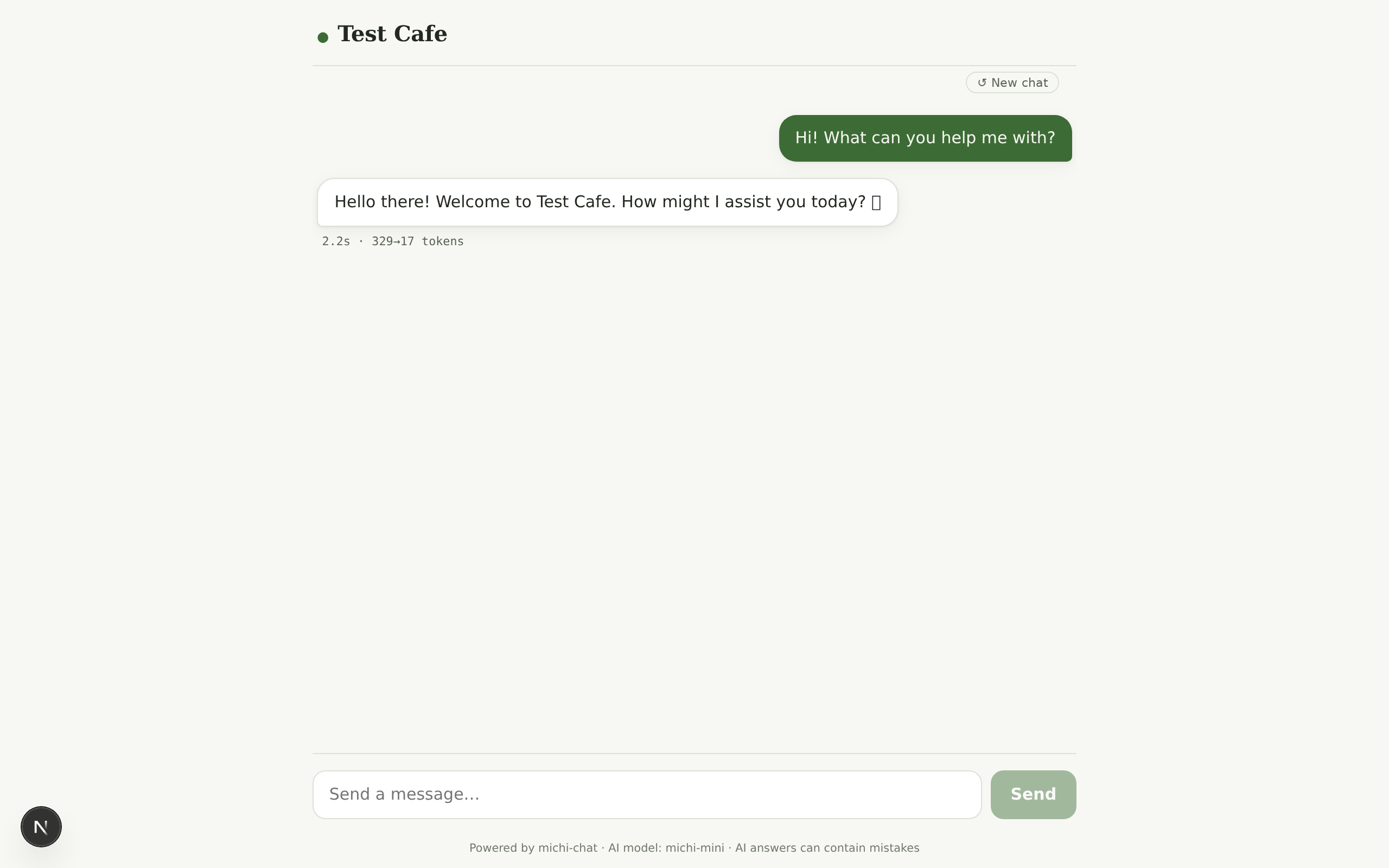
Add a trial alias in the yaml (say, gemma → ollama_chat/gemma3:4b, or the bundled michi-mini → gemma3:1b economy tier), restart the litellm container, and set one tenant's Model alias field to it in the admin UI. That tenant now runs the new model while every other tenant is untouched - A/B testing as configuration. The alias in use is shown to visitors in the chat footer ("AI model: …").
Smaller-model honesty: a ~1B model answers roughly 3x faster than a 4B one, but tool-calling reliability degrades. Before switching a real tenant down a size, run kb:eval and a handful of real tool questions against it.
The embedding caveat
The knowledge-base column is sized to 768 dimensions (nomic-embed-text). Changing the embed alias to a model with different dimensions requires a schema migration and re-embedding every document. Change michi and judge freely; think twice about embed.